
Agile Defense · Deep dive
Make the idea tangible before the contract.
Ten-day sprints turn stakeholder input into an interactive concept, supported by reusable workshop methods.
Results
10 days
Pre-Discovery sprint
~20
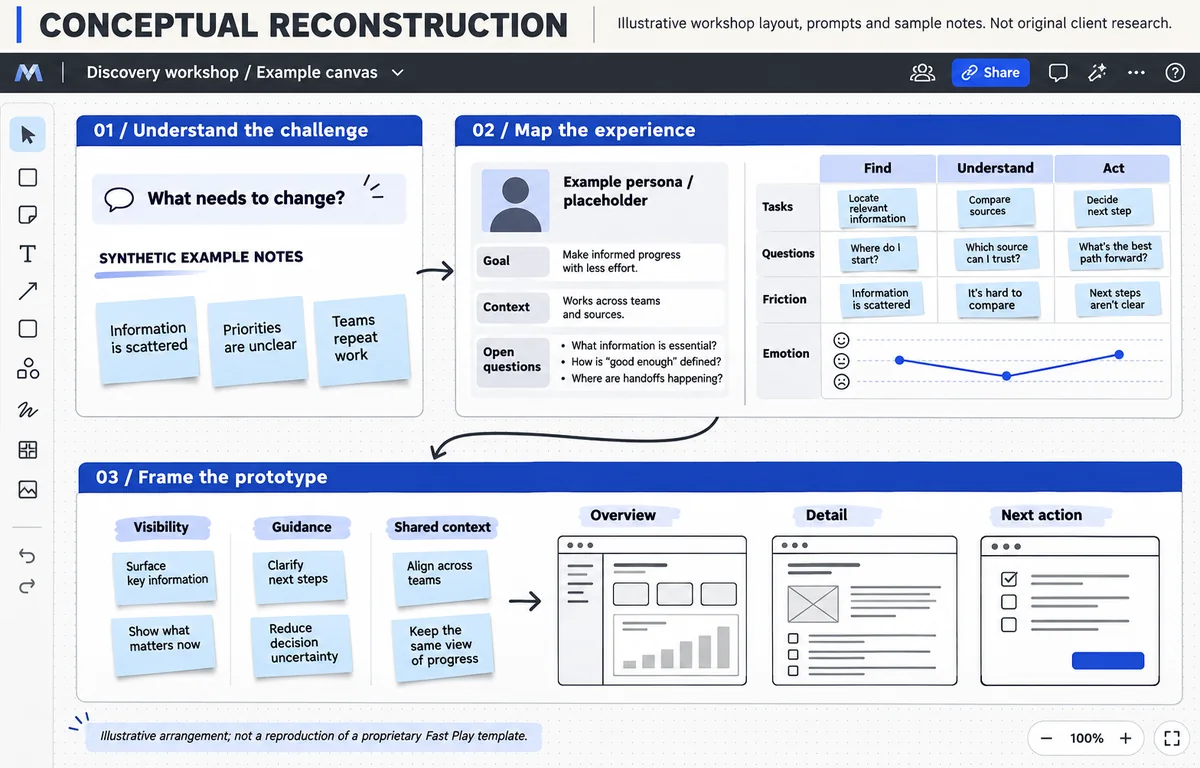
Fast Plays workshop templates
4
Concept dashboards I contributed to
Contract wins are a team and company outcome.
Prove the idea with limited access.
Agile Defense wanted to show a customer how it would solve a real challenge before anything was signed, and before the customer could give access to its users or data. Pre-Discovery was the answer: a 10-day sprint that starts with stakeholder interviews and ends in an interactive prototype that can serve as the basis for the solution if the company wins the work. A win could expand an existing contract or open a new line of business.
The sprint needed workshops, and plenty of workshop methods already existed. The team wanted the 20 or so most frequently used ones as quick-hit templates anyone could pick up and run on their own, with a five-minute introduction, even with a prospective customer in the room.
- Time
- Ten days, from stakeholder interviews to a prototype walkthrough
- Users
- Subject matter experts stand in as proxy users, because ten days isn’t enough time to reach real end users
- Data
- Synthetic, because real data is usually behind access restrictions before a contract
Help shape the sprint and run the workshops.
I help run Pre-Discovery sprints with our team of four, and I helped design the process with my team, workshopping it in Mural.
- Fast Plays
- The team listed the methods we used most often. I made Mural templates for them, about 20 in all, and shared them with the company.
- Workshops
- I run the workshops on our team, so I usually choose the Fast Play that fits what we know about the work.
- Dashboards
- I contributed to four concept dashboards that came out of these sprints.
How a sprint runs
- Day oneWorkshop and personasOne person runs a stakeholder interview or workshop while another fills out the personas and journey map
- User storiesCo-created in a modified Scrum process, planned in Mural
- Sketches to prototypeUser stories become sketches, then an interactive Figma prototype on synthetic data
- WalkthroughWith the customer, through realistic scenarios
Test a few methods before expanding the library.
Start with three templates and test them ourselves
HowIn 2024, we set out to template the 20 or so methods we used most often. We kept them internal at first, started with three, and tested them ourselves before sharing more widely. In practice, five to seven get used again and again, and they cover the discovery phase.
Run the workshop and fill out the personas at the same time
WhyThat checks we’re headed the right way before any prototyping and leaves most of the 10 days for building the concept.
Use proxy users and synthetic data
WhyTen days isn’t enough time to reach real end users, and real data is usually behind access restrictions before a contract. Subject matter experts stand in as proxy users, and the prototype is filled with synthetic data. The customer knows, because it has not given us its own data.
Agree on the key terms up front
ExampleOn the readiness dashboard, we also agreed on what “readiness” meant.
Give customers something they can react to.
Pre-Discovery sprints have helped win federal contracts. In one engagement with a prospective client, a four-hour session built on one of the Fast Plays produced persona profiles that guide the client’s UX strategy. The first prototypes were ready in five days and refined over two weeks. The company won that contract and did the work.
Four concept dashboards came out of these sprints, each with a prototype the company can build the real solution from if it wins the work. Fast Plays let anyone at the company set up and run a discovery workshop in minutes, even before every stakeholder is known, without deep facilitation experience.