
Case study · Federal
Prove the idea before anyone signs.
I contribute to concept prototypes for federal customers, project-manage a four-person design team, and help build the company's AI training.
Results
4
Concept dashboards contributed to
~1,500
Employees reached through AI training
10 days
Pre-Discovery sprint, kickoff to prototype
4
People on the design team I project-manage
Contract wins are a team and company outcome.
Federal agencies don't sign on a pitch deck.
Every engagement starts the same way: prove the idea works before anyone commits real budget to it, on a clock measured in days, not quarters. Later, the company faced a version of the same problem internally: "make the company AI-native" is a slogan until around 1,500 employees have an actual path to act on it.
Prove it with a working prototype.
Pre-Discovery is the company's answer to the first problem: a 10-day sprint, stakeholder interviews, and a modified Scrum process that ends in a working concept prototype. Ten days isn't enough time for real end-user access, so we design around proxy users from the start. I helped design that process with my team, workshopping it in Mural, and I help run it. A customer can see and use a working prototype before competitors have written a proposal, and these sprints have helped win federal contracts.
Once a customer signs, a longer Discovery program, 30, 60 or 90 days with real users and data, takes the research further, with workshops, usability testing, surveys and analytics review at each stage.
I've contributed to four of those prototypes, each one a full concept dashboard built in Figma and Mural for a different problem, and each one came with personas and journey maps.
Readiness dashboard
Risk assessment, readiness, and training views in one place.
DREAMS
A workforce and HR dashboard: hiring flow, role assignment, and leadership metrics in place of siloed legacy systems.
GUARD
An infrastructure dashboard that consolidated siloed data sources into one view for faster response.
COMPLY
A compliance dashboard giving leadership a real-time view of assessment activity across offices.
The same discovery-first thinking, at company scale.
Agile Defense University and AI Foundations
The AI problem needed a different kind of prototype: a curriculum. I’m the project manager for Agile Defense University, built on the company's own AI Learning → AI Leaning → AI Leading adoption framework. My team and I draft storyboards, write and validate scripts, then update the storyboards to match before anything moves into production, the same repeatable pattern we're now using to build out the rest of ADU. ADU's goal is for every employee to know exactly where they stand on their career path and to have something they can act on immediately, at whatever speed makes sense for them. The ADU hub is live and part of new-hire orientation, and I helped design the manager feedback form and the Career Baseline Assessment.
The clearest example is AI Foundations, which we released to the whole company in August 2026. It explains AI so anyone can follow it: where it came from, what it is, how to use it well, and what can and can’t go into an AI system depending on someone’s clearance and the classification of the information. Every employee now takes it before using our internal AI tools. I helped storyboard, script, and build it. Make the problem simple, then solve the simple problem: that course is the rule in practice.
How ADU builds a course
The discovery and process work below was designed for creating and revising training across ADU, including PM Training, AI Foundations, and training for Communities of Practice and Communities of Interest. I redrew each board in a simulated board interface with paraphrased notes.
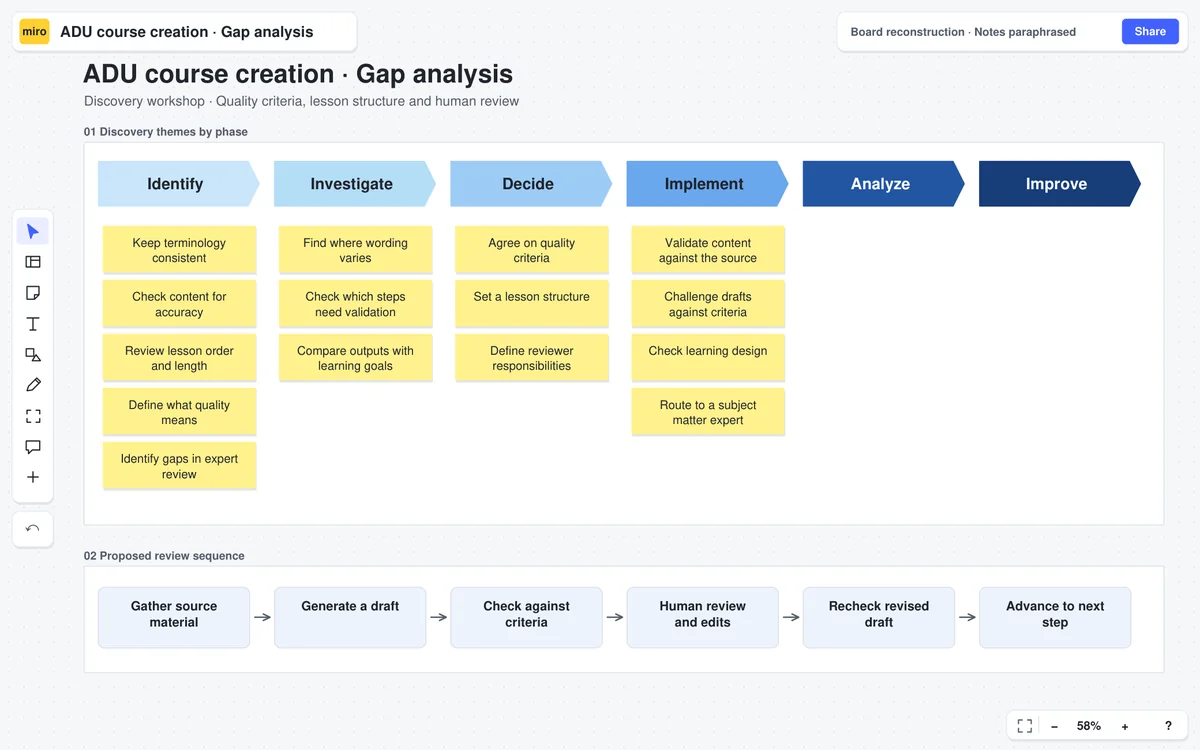
Identify, Investigate, Decide and Implement carry themes about consistent wording, content accuracy, lesson design and subject matter expert review. Analyze and Improve are open. The review sequence at the bottom is a proposal from discovery: a check against quality criteria, then human review, revision and a recheck.
The team then compared two ways to draft, check and revise course materials. Both are explorations, so they describe options the team weighed.
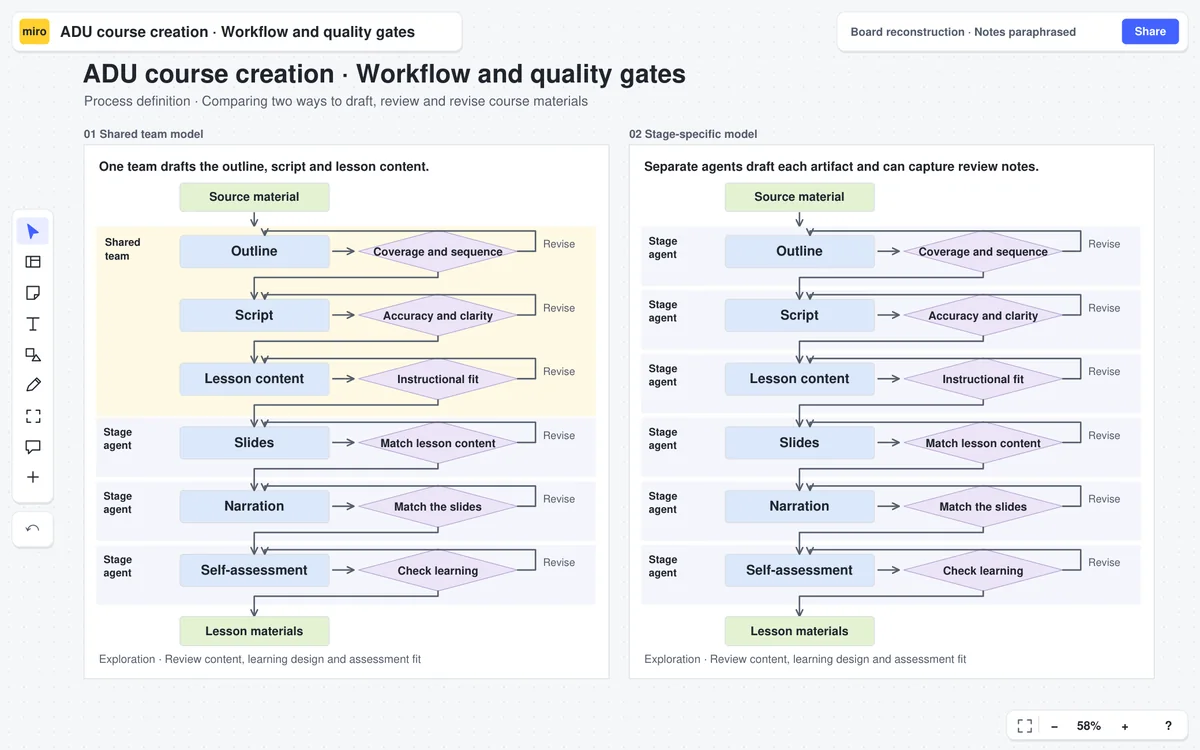
The shared team model groups the outline, script and lesson content. The stage-specific model has separate agents draft each artifact and capture review notes. Both start from source material and check the outline, script, lesson content, slides, narration and self-assessment before assembling lesson materials.
Addie is ADU’s teacher and training avatar. The team designed her voice and look in HeyGen, and her name comes from the A and the D in Agile Defense.
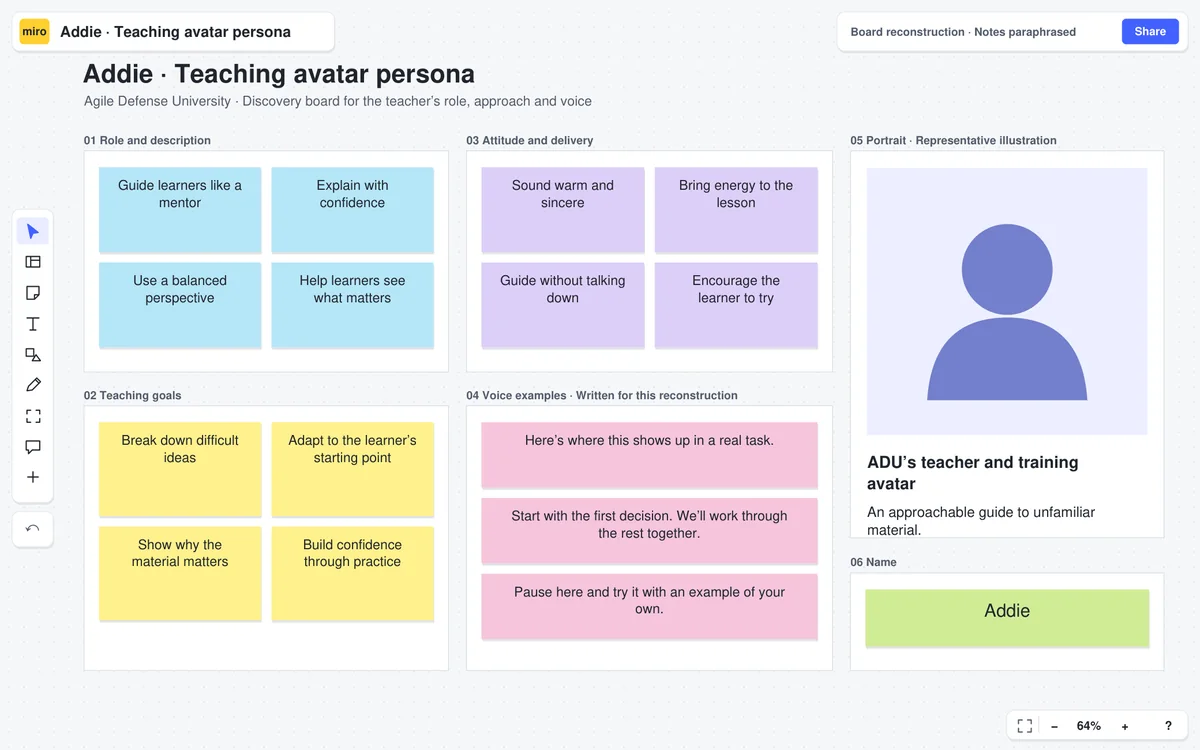
The board describes a mentor-like guide with plain language and a warm tone. The portrait is a representative silhouette, and the voice examples were written for this reconstruction.
How ADU builds PM Training modules
PM Training, the Program Manager training course, is the worked example. A module moves through four stages: an ingest workshop, an outline workshop with the subject matter expert (SME), a script review, and a storyboard. I ran the workshops. The People Management module shows the first two stages.
The ingest workshop defines what learners should be able to do, brainstorms content, and identifies the artifacts and resources they’ll need.
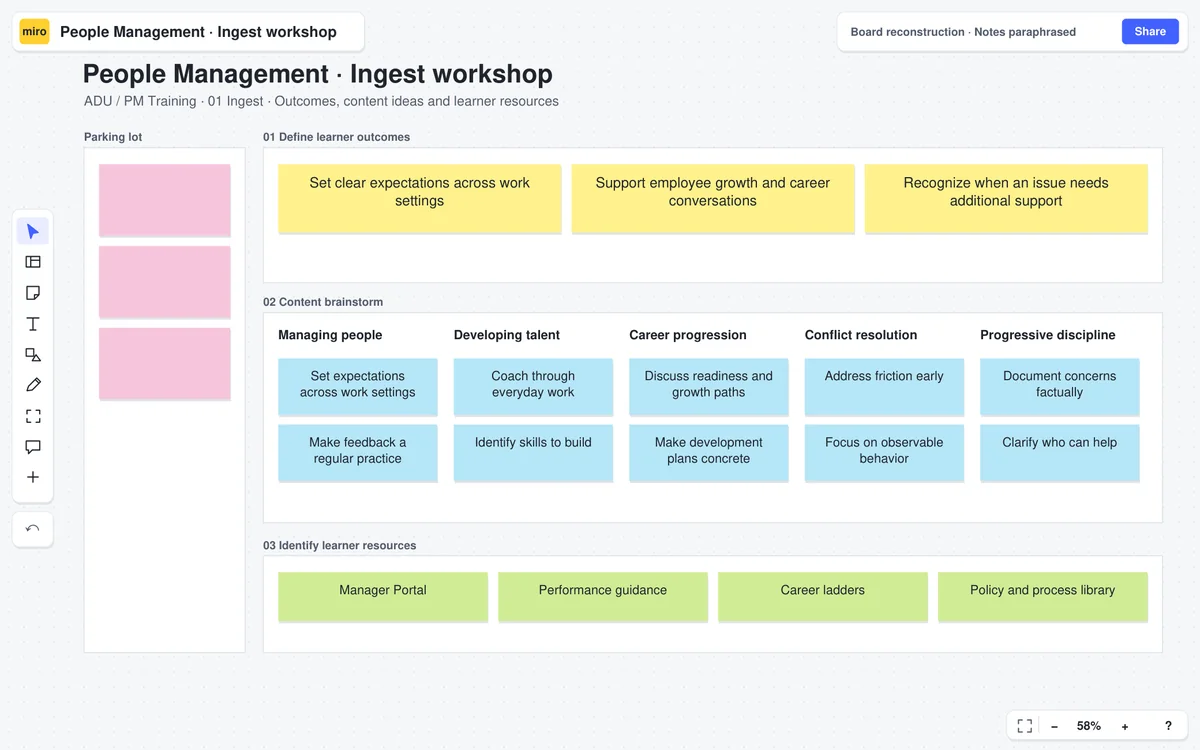
The board groups ideas about managing people, developing talent, career progression, conflict resolution and progressive discipline. It also lists resources such as manager and performance guidance, career ladders and a policy library.
In the outline workshop, the ingest findings become an outline for a 10-minute module. The SME and their designated team review it to validate what the first workshop surfaced and to fill gaps.
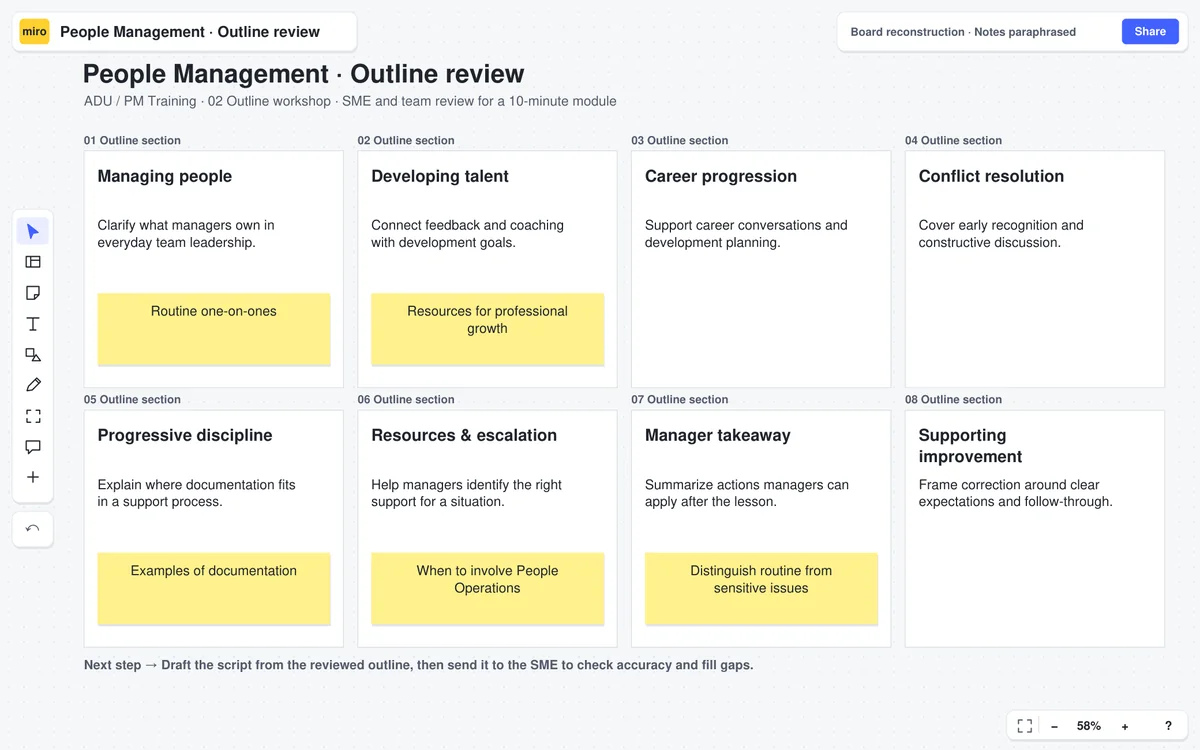
The outline covers people leadership, talent, career growth, conflict, discipline, escalation, manager takeaways and supporting improvement. The yellow notes are selected feedback themes.
The script comes next. It’s drafted from the reviewed outline, then goes to the SME to verify accuracy and catch gaps that surfaced after either workshop.
The storyboard sketches each scene against the spoken script, proposes graphics, and gives the SME a chance to suggest existing visuals or presentation materials. Procurement & Vendor Management is the module shown here.
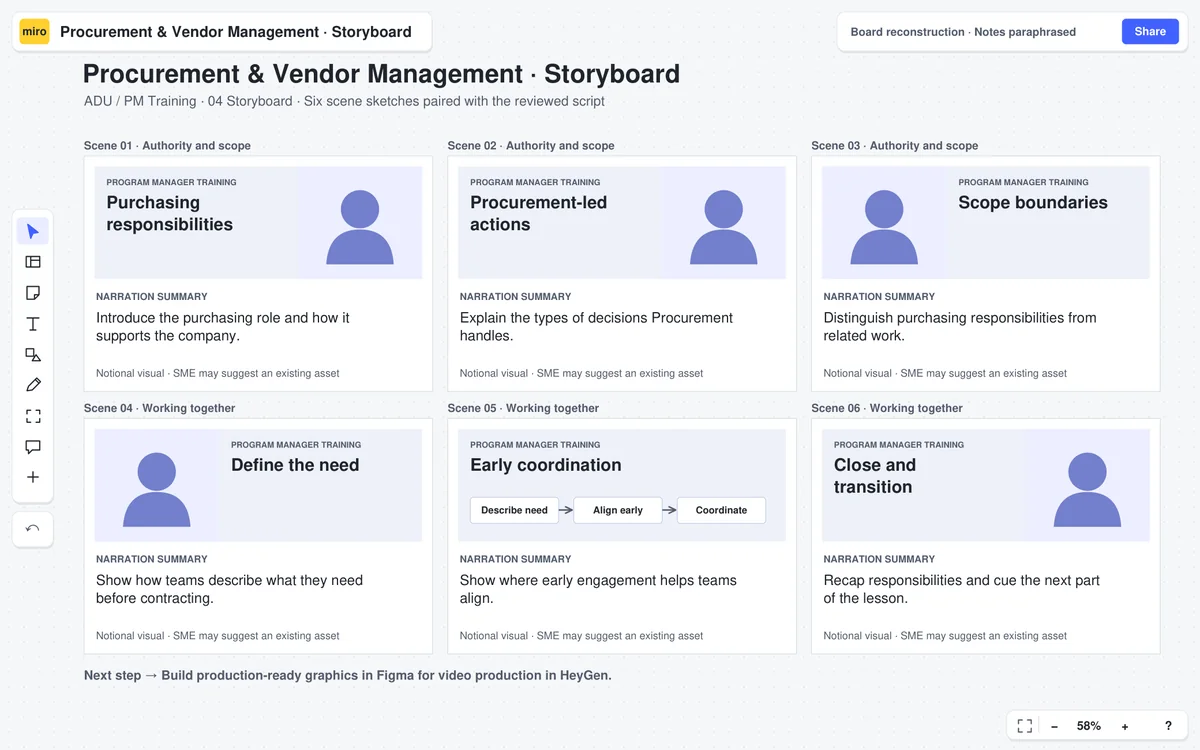
The first row introduces Procurement authority and scope. The second covers defining the need, coordinating early and closing the section. The visuals are notional and the narration is summarized.
After storyboarding, the team builds production-ready graphics in Figma and brings the finished assets into HeyGen for video production.
Data fabric pilot
I project-managed a 16-week, 8-sprint pilot of a data fabric ecosystem, starting in April 2025. The team had 13 people (strategists, architects, data engineers, developers and governance advisors) working with five client stakeholders, and I supported discovery along the way. It went live as a working system in 16 weeks. The client asked for more work, and other organizations asked for something similar.
Experience Studio and Fast Plays
I’m also the project manager for Experience Studio, the four-person design team behind this work, co-led the Labs project management office for six months during a post-merger reorg (reorgs are never as clean as the org chart makes them look), and helped create Fast Plays. They started as our internal methods wiki and became my contribution to Pre-Discovery’s design: about 20 templated workshop methods that let me set up a discovery workshop in minutes, even before every stakeholder is known, and that any employee can run without deep facilitation experience.
Course video pipeline
The video pipeline for our program management course got the same treatment. Its graphics came from one graphic designer working in Illustrator, one finished module every two weeks, and the team was behind on a strict deadline. I set up a Figma design system in about half a day so assets became drag-and-drop and anyone on the team could jump in. The team went to three modules in three days and ended up two days ahead of schedule. The course is still in production.
Solutions Architect Jira board
Solutions Architects had the same problem in miniature: a multi-phase process tracked in an Excel sheet that one person kept. I designed a Jira board with the VP of Solutions that auto-populates each phase's subtasks, linked to the OneDrive folder holding that phase's artifacts and a reference for how to fill each one out. A new solutions architect can join an effort already in progress, at any phase, and know immediately what to do and where to find it, without tracking someone down to ask.
Something to react to before signing.
Four concept prototypes gave clients something to react to before signing anything: real screens, realistic synthetic data, and real decisions about what leadership needs to see first. ADU is now teaching around 1,500 employees the same discovery-first thinking, at company scale.
- Project-managed a 16-week, 8-sprint data fabric pilot that went live as a working system and drew requests for similar systems
- Course pipeline: set up a Figma design system that took output from 1 module in 2 weeks to 3 modules in 3 days
- Help design and run 10-day Pre-Discovery sprints, which have helped win federal contracts
- Contributed to 4 concept dashboards through Pre-Discovery
- AI Foundations: required for every employee before using our internal AI tools
- Around 1,500 employees reached through Agile Defense University
- Project manager for Experience Studio, a 4-person design team
- Fast Plays: about 20 templated workshop methods that set up a discovery workshop in minutes
- TASK Agents: AI agents that turn interview notes and stakeholder feedback into personas, affinity maps and themes, which I helped build
- Jira board built for the Solutions Architect team, so a new SA can join an effort at any phase and know immediately what to do